GuideUpdated October 2026
What is a player-driven PvP space MMO?
Quick answer
A player-driven PvP space MMO is an online space game where players, not the developer, supply most of the content: they mine, craft, trade, set market prices and destroy each other's ships, and real loss (often full loot) keeps the economy turning. EVE Online is the classic example. Vermillion Online is a new, free playtest in the genre with ships built block by block and flown with Newtonian thrust.
A space MMO where the other players are the content. They mine the ore, set the prices, build the ships and blow them up. Here's how the genre works, what to look for, and where Vermillion Online sits in it.
The short version
Most online games are built around content the developer made: quests, raids, dungeons. A player-driven MMO flips that. The developer builds rules and resources, and players supply the rest. Someone mines the ore. Someone else hauls it, and maybe gets ambushed on the way. Someone builds the ship that ambushed them. Prices on the market are whatever players agree to pay.
Add PvP with real loss and the whole thing gets weight. If ships can be destroyed and their cargo taken, every ship matters, so every ship has to be replaced, so somebody has to mine, refine and build again. Destruction keeps the economy turning. That loop is the heart of the genre.
What makes a space MMO "player-driven"
A lot of games use the label loosely. These are the parts that make it true in practice:
- Players make the goods. Ships, ammo and parts come from player mining and crafting, not an NPC shop with infinite stock.
- Players set the prices. A market with buy and sell orders, where the price is whatever the last trade was.
- Location matters. If an item exists at one station, someone has to move it. Hauling becomes a job, and a target.
- Loss is real. When a ship dies, value leaves the game or changes hands. Without that, nothing needs replacing.
- Risk is graded. Safer space pays less. Dangerous space has the best resources. Players pick their own risk.
EVE Online is the reference point for all five, and has been for over twenty years. Albion Online took the same ideas into a fantasy world. Our EVE comparison and Albion comparison go into how those games handle it.
Full loot, and why people want it
Full loot means that when you lose, what you were carrying can be taken. It sounds harsh. It's also the reason the genre works. A safe trip means nothing if no trip can fail. Full loot turns a mining run into a decision: how much to carry, which route, whether to bring an escort, whether that contact on radar is a miner or a hunter.
Good full-loot games soften the floor without removing the stakes. You keep something to come back with, and the worst losses happen where you chose to go. In Vermillion that floor is a free Rookie Ship, and the worst losses happen in Low security and Lawless space.
Security zones: picking your risk
Almost every game in the genre splits space into tiers. The names differ, the idea is the same: near home, aggression is punished; far out, nothing is. Here is how Vermillion's map works today:
| Tier | Sectors | Rules | Best ore |
|---|---|---|---|
| Secure | 1 | No damage. | Ferrite, Cuprite (starter belts) |
| High security | 6 | Attacks land. The attacker turns Criminal; police destroy them after 20 s. Suicide ganks possible. | Volatile Ice, Bauxite |
| Low security | 9 | No police. Criminals are fair game. Station guns. | Titanite (only here), Galenite |
| Lawless | 3 | No rules. | Iridium (only here), Galenite |
That structure isn't new. EVE and Albion both use a version of it. What's different is what you fly through it.
Where ships come from
This is where space MMOs split into very different games.
Bought and fitted
In EVE Online and Elite Dangerous, ship hulls are fixed designs. You buy or build a hull, then fit modules into slots. The depth is in the fitting. Star Citizen also uses fixed ships, with components you can swap.
Built block by block
In building games like Space Engineers, Starbase and From the Depths, you design the ship itself. The shape, the armour, where the engines go. A few online games have tried to put this into a persistent PvP world. It's hard, because every ship is a different physics object and every hit has to land on a real block.
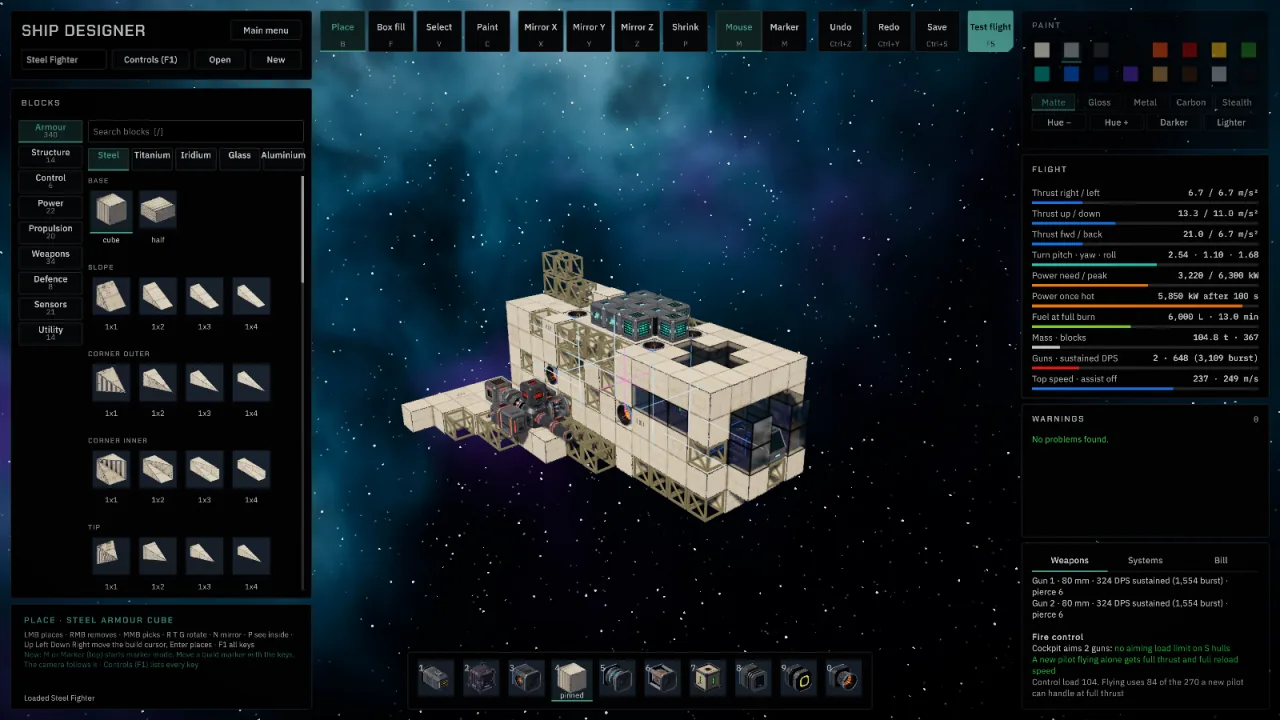
Vermillion Online is in this second camp. You build in 1 m blocks, and the insides matter: engines, thrusters, cannons, radar and mining lasers are assemblies of parts, and bigger assemblies trade performance for mass and heat. Read games like From the Depths for more on that style.
How flight works matters more than you'd think
In a PvP game, the flight model is the combat model. Point-and-click flight (EVE) makes fights about positioning, fitting and fleet orders. Flown flight (Elite, Star Citizen) makes them about piloting. With block-built ships there's a third layer: the design itself decides how the ship handles.
In Vermillion, flight is Newtonian on six axes, with flight assist you can switch off. Thrust comes from where you placed the thrusters, so a ship with too little thrust forward or a lopsided layout flies badly. There's no speed cap. Typical ships reach 150 to 300 m/s based on thrust, size and mass.
Information is a weapon
A good PvP space game controls what you can see. In Vermillion, the server only sends you what your sensors detect. Ships give off a signature from thrust, heat, guns and radar. Asteroids hide you. Firing your radar reveals ore fields and pirate sites, and every other pilot in range hears the ping as a bearing. Hunting and hiding are part of the game, not a menu option.
What to look for when picking one
- Population vs. stage. An established game has big fleets and a deep market. A new one has empty routes and prices nobody has set yet. Both are valid; know which you want.
- What loss costs. Insurance, rebuy, clones, full loot? Read the rules before you fly anything you love.
- Where the time goes. Some games are mostly travel, some mostly menus, some mostly building. Watch unedited footage.
- Business model. Subscription, premium, ship packs, one-off price. Check what's required to play the part you care about.
- Platforms. Mac support is rare in this genre. Check before you get attached.
Where Vermillion Online fits
| Genre | Player-driven PvP space MMO with block-built ships |
|---|---|
| Status | Free playtest; progress may be wiped |
| Price | Free download on itch.io; no price set for later |
| Platforms | macOS and Windows |
| Server | One EU server (Nuremberg); everyone shares one world |
| Map | One zone, 19 sectors over about 200 km; 6 stations |
| Ship building | 1 m blocks: 68 armour shapes in 5 materials plus about 140 parts; engines, thrusters, cannons, radar and mining lasers are multi-part assemblies |
| Flight | Newtonian, 6 axes, flight assist toggle; thrust comes from where you placed the thrusters |
| PvP rules | 4 security tiers: Secure (no damage), High security (police destroy attackers after 20 s), Low security (no police), Lawless (no rules) |
| On death | Full loot: half the cargo destroyed, the rest left in the wreck; hulk salvageable; free Rookie Ship |
| Economy | Player order book at every station, 2% tax, no global inventory |
| Players | Early: a handful of pilots per session so far |
Vermillion Online is a small, early entry. It takes the EVE and Albion structure (player market, security tiers, full loot) and puts block-built, Newtonian ships into it. It's a free playtest on Mac and Windows with one EU server and not many players yet. Progress may be wiped between rounds.
If you've wanted From the Depths-style engineering with EVE-style stakes, that's the game we're making. If you want a huge population and twenty years of content today, EVE is the better pick. The comparison hub lays out the trade-offs game by game.
Related
See it from the cockpit
Vermillion Online is an early playtest of exactly this kind of game, with ships you build block by block. It's free to download.
Playtest: progress may be wiped. One EU server. The builds are unsigned, so macOS and Windows warn you once on first launch.