ComparisonUpdated October 2026
Vermillion Online vs Star Citizen
Quick answer
Star Citizen is Cloud Imperium's huge first-person space sim, still in alpha, where you buy a game package and fly studio-made ships across seamless planets. Vermillion Online is a small, free playtest where you design ships block by block, fly them with Newtonian thrust and lose them to full-loot PvP in a player-run economy. Pick Star Citizen for fidelity and scale; try Vermillion if you want to build your own ship and play for keeps.
Both games have you walking around your own ship, flying it with real physics and getting out on EVA. Past that they are very different games, at very different stages. Here's how they compare.
Facts as of October 2026Star Citizen is a game by Cloud Imperium Games
The short answer
Star Citizen is Cloud Imperium Games' crowdfunded space sim, playable as an ongoing alpha. It's huge in scope: seamless planets you can land on, first-person everything, big multi-crew ships, and a persistent universe that now spans more than one star system. To play you buy a game package that includes a starter ship. More ships can be bought with real money or earned with in-game currency. It runs on Windows PCs and asks a lot of your hardware. Crafting arrived in Alpha 4.7 in March 2026; the single-player Squadron 42 is now planned for 2027.
Vermillion Online is tiny by comparison. It's a free playtest on Mac and Windows with one EU server. Its focus is narrow: block-built ships where the insides matter, a player-run market, and full-loot PvP in risk-graded space. You don't buy ships at all. You design them, test-fly them free, and fabricate them from materials you mined or bought.
| Vermillion Online | Star Citizen | |
|---|---|---|
| Stage | Free playtest, early development, progress may be wiped | Playable alpha, in development since 2012 |
| Price | Free download on itch.io; no price set for later | Buy a game package with a starter ship (from about $45 at time of writing, no subscription); extra ships sold for real money or earned in game |
| Platforms | macOS and Windows | Windows PC |
| Getting ships | Design block by block or use stock designs; fabricate from refined materials | Fixed ship models, bought or earned; components can be swapped |
| Flight | Newtonian 6-axis; thrust from where you placed thrusters; flight assist toggle | Newtonian with a flight control system, from the cockpit |
| Damage | Per block; shells chew through armour; hulls split into fragments | Per component and hull section |
| On ship loss | Half the cargo destroyed, rest in the wreck; hulk salvageable; free Rookie Ship | Ship insurance returns the hull after a claim; cargo and carried gear can be lost |
| PvP rules | Secure, High (police after 20 s), Low, Lawless | Armistice zones at landing zones; crime stat and bounties in lawful space; lawless systems |
| Economy | Per-station player order books; no global inventory | Mostly NPC shops and missions, with player trading, hauling, mining and crafting |
| On foot | Magnet boots, jetpack EVA, boarding, pistol and rifle | Full first-person shooter, planets, cities, interiors |
| Planets | No landing; the planet is a skybox | Seamless planetary landing |
Star Citizen details from the official RSI site and patch notes. Its systems change between alpha patches; corrections welcome on Discord.
The big difference: buy a ship or build one
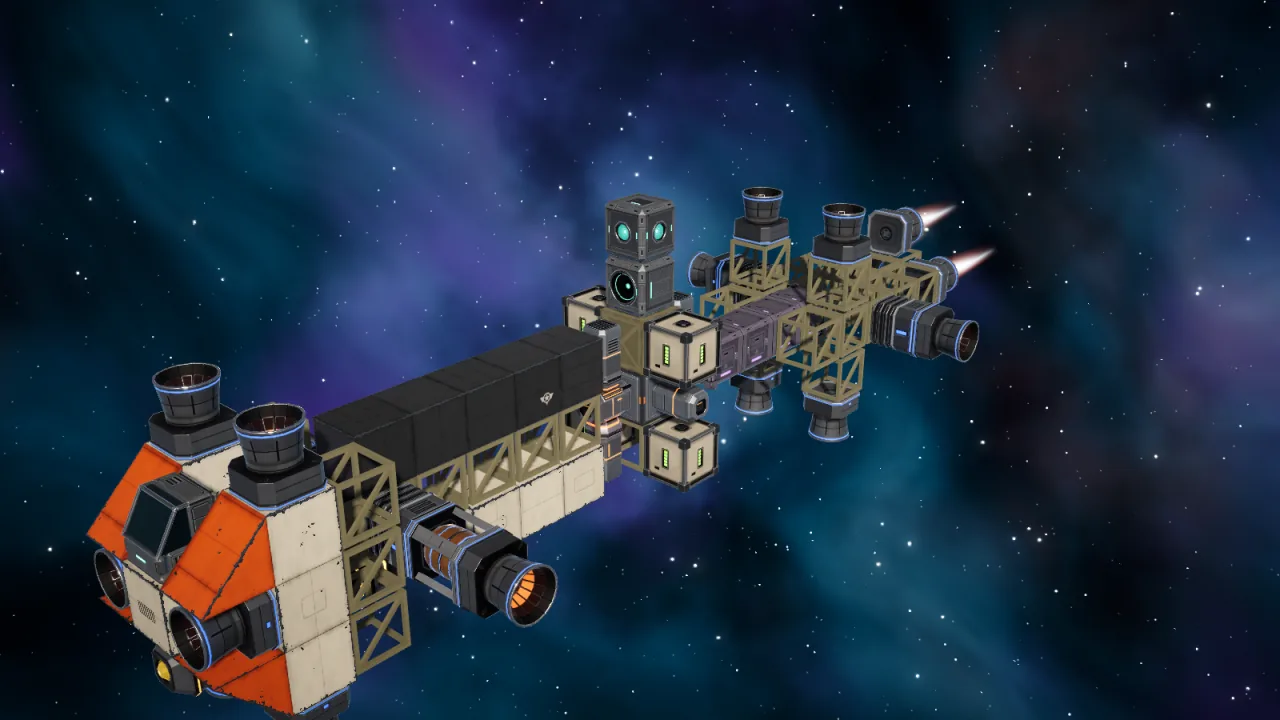
In Star Citizen every ship is a model designed by the studio. That's why they look the way they do, and it's why you can buy them. In Vermillion, ship design is the game. The Ship Designer at a station places 1 m blocks: 68 armour shapes in Steel, Aluminium, Titanium, Iridium composite or Glass, and about 140 functional and structural parts.
The insides are built from parts, From the Depths style. An engine is a core plus cylinders plus coolers. A thruster is a nozzle plus amplifiers plus coolers. A cannon is a firing piece plus barrels, clips, autoloaders, gauge increasers and recoil absorbers, with a gauge from 12 to 300 mm. Power, fuel, heat and ammo are all simulated, and every block can be shot off.
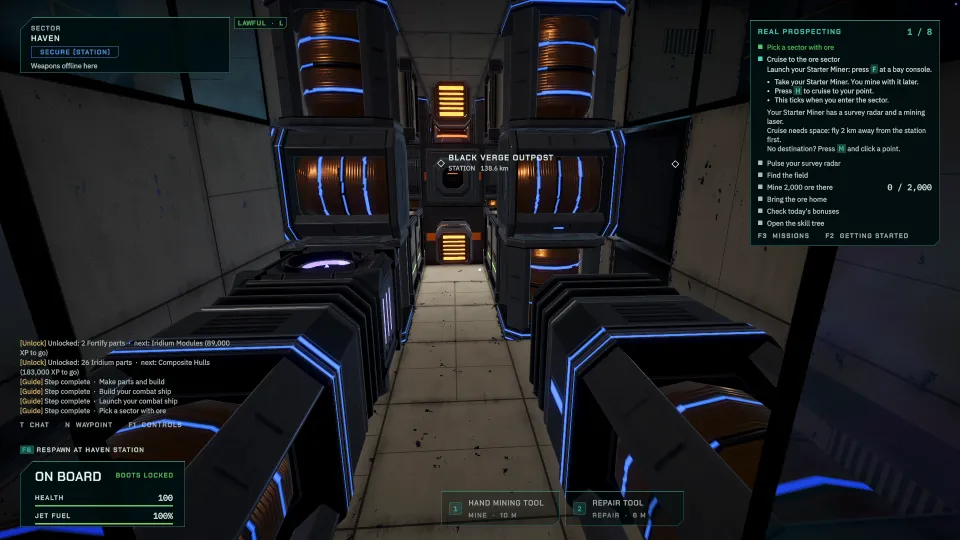
Because design is the game, nothing is for sale. There are stock designs to start from (Rookie Ship, Starter Miner, Steel Fighter, Corvette, Starter Hauler and others), and the first real goal is to mine ore in the free Rookie Ship and fabricate your own Starter Miner.
Flying
Both games are Newtonian. Star Citizen gives every ship a tuned flight model. In Vermillion the flight model comes out of your design: thrust comes from where you placed the thrusters, so a badly balanced ship flies badly. There's no speed cap. Top speed falls out of thrust, size and mass, and typical ships sit around 150 to 300 m/s. Flight assist can be switched off.
PvP and losing things
Star Citizen protects landing zones with armistice areas, tracks crime with crime stat, and lets you claim a destroyed ship back through insurance. Vermillion is harsher. There is no insurance. A destroyed ship loses half its cargo, the rest spills into its wreck for anyone, and other players can salvage the hulk. A dead character drops a body bag with everything carried, half of it destroyed. Everyone aboard dies with the ship. What softens it is a free Rookie Ship, so you can always get back out.
Space is split into four tiers. Secure has no damage. High security lets attacks land, but the attacker turns Criminal and invisible police destroy them 20 seconds later. Low security has no police and station guns that shoot criminals. Lawless has no rules, and the best ore: Iridium is only found there.
Economy
Vermillion's economy is player-run on purpose. Every station has an order book with buy and sell orders, escrow and a 2% tax. Items exist at one station, so goods have to be hauled, and courier contracts with collateral let you pay someone else to risk it. NPCs set price floors and supply pirates, and that's about it.
What Star Citizen does better
- Visual fidelity and scale that very few games come close to.
- Seamless planets, cities and interiors, and a full first-person shooter layer.
- A huge roster of hand-made ships, from snub fighters to capital ships.
- A big, active community and years of content in the persistent universe.
Vermillion can't land on planets (the planet you see is skybox art), has one star system, one server, and a handful of pilots per session so far. Its art is much simpler.
Common questions
Can you build your own ships in Vermillion Online?
Yes. That is the core of the game: the Ship Designer places 1 m blocks, and engines, thrusters, cannons and radar are assemblies of parts. You can test-fly a design for free before fabricating it.
Can you buy ships with real money in Vermillion?
No. Ships are fabricated in game from refined materials. The playtest is free and no price has been set for later.
Can you land on planets in Vermillion Online?
No. The planet you see is skybox art. Play happens in space, around asteroids and stations.
Is there ship insurance in Vermillion?
No. A destroyed ship is gone: half its cargo is destroyed and the rest is in the wreck for anyone. You always get a free Rookie Ship.
Does Vermillion Online run on Mac?
Yes, on macOS and Windows. Star Citizen runs on Windows PCs.
Who should play which
Play Star Citizen if you want the most detailed first-person space sim around and you're fine with alpha bugs and a PC that can handle it. Try Vermillion Online if what you really want is to design your own ship, fly it into dangerous space for better ore, and live with the loss when it goes wrong. It's free, it runs on a Mac, and it's early enough that your feedback changes it.
Also worth reading: Vermillion vs Elite Dangerous, games like Starbase, and the FAQ.
Design the ship instead of buying it
If you've ever wished you could build your own ship in a game like Star Citizen, Vermillion's playtest lets you do exactly that. It's a free download.
Playtest: progress may be wiped. One EU server. The builds are unsigned, so macOS and Windows warn you once on first launch.