The closest games to From the Depths are Stormworks (deep engineering, rescue sim), Space Engineers and Avorion (block-built spaceships), Besiege (physics siege machines), Crossout (vehicle-building PvP matches) and Trailmakers (lighter co-op building). Vermillion Online is a free playtest that brings FtD-style multi-part engines and cannons into an online PvP space MMO on a dedicated server, with a player economy and full loot.
From the Depths is the game where a cannon is six kinds of block, an engine is something you engineer, and every hit takes a real chunk out of your design. Few games go that deep. These are the ones that come closest, each in a different direction.
Facts as of October 2026From the Depths is a game by Brilliant Skies
What makes From the Depths special
Lots of games let you build vehicles. From the Depths is rare because the systems are built from parts too. An Advanced Cannon isn't a gun block: it's a firing piece with barrels, autoloaders, ammo clips, gauge increasers and recoil absorbers, and the shape of that assembly decides how it shoots. Engines are built the same way. Damage lands on individual blocks, so a well-protected ammo store matters. And it all works at sea, in the air and in orbit.
When people search for games like it, they usually want one of three things: the same deep engineering, the same per-block destruction, or the same building but with other people. Here's what fits each.
The list
Vermillion Online
Online PvP space MMO · free playtest · Mac and Windows
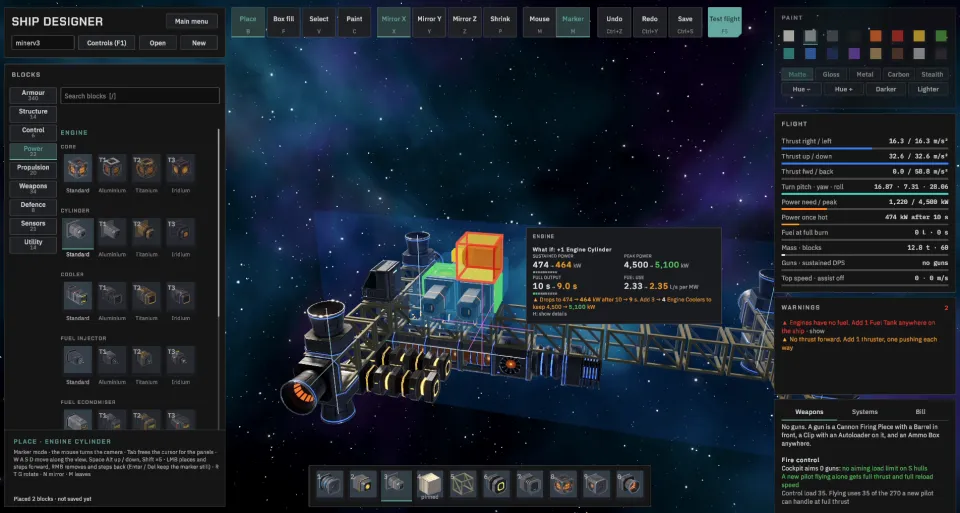
The disclosure first: this is our game. It's here because it's built directly on From the Depths ideas and moves them into a persistent online world. Insides matter: engines are a core plus cylinders plus coolers, thrusters are a nozzle plus amplifiers plus coolers, and cannons are a firing piece plus barrels, clips, autoloaders, gauge increasers and recoil absorbers, with a gauge from 12 to 300 mm. Bigger assemblies give more performance, more mass and more heat. Power, fuel, heat and ammo are simulated.
Ships are built in 1 m blocks (68 armour shapes in 5 materials, about 140 functional parts) and fly on Newtonian thrust from wherever you placed the thrusters. Shells are simulated projectiles that chew through blocks until penetration runs out; hulls split into drifting fragments. The difference from FtD is the world around it: one shared server, a player-run market, mining, and full-loot PvP. You can also walk around inside your ship with magnet boots. It's an early playtest, with a small player count and possible wipes.
Stormworks: Build and Rescue
Vehicle building and rescue sim · single-player and co-op
The closest match for engineering depth. You build boats, aircraft and vehicles, then wire up engines, fluid systems, electrics and logic, with Lua scripting for custom displays and autopilots. The focus is rescue missions and surviving the weather rather than fighting, though weapons were added later. Great if the part of FtD you love most is making machines work. Multiplayer is peer-to-peer co-op or PvP.
Space Engineers
Block-building space sandbox · single-player and multiplayer servers
Keen Software House's long-running sandbox. Large and small grids, survival mining and crafting, planets, programmable blocks and a huge Workshop of ships. Systems are mostly single blocks rather than assemblies, so engineering is about layout and conveyors more than building a gun from parts, but the scope is enormous. Keen's sequel, Space Engineers 2, has been in Early Access since January 2025 on a new engine; it's single-player for now, with co-op planned for early 2027. Vermillion vs Space Engineers.
Avorion
Block-building space sandbox · single-player, co-op and servers
You build ships from blocks you can scale freely, then fly them across a procedurally generated galaxy toward its centre. Turrets are crafted and slotted, fleets can be commanded, and there's trading and factions. Less granular than FtD inside the ship, but quick to get into and great with friends. Vermillion vs Avorion.
Besiege
Physics building puzzles · single-player and multiplayer
Medieval siege machines built from blocks, then let loose on castles and armies. No economy or campaign map, just physics and a lot of satisfying destruction. A good pick if you like the "will this design actually work" moment more than the long campaign.
Crossout
Online vehicle-building PvP · free to play
Post-apocalyptic cars built from parts, fought in short online PvP matches. Damage comes off parts, so a lucky shot can take your wheels or your gun. It's session-based combat rather than a persistent world, with its own crafting market. The most direct "FtD-style damage against real players" option that's been running for years.
Trailmakers
Vehicle building adventure · single-player and co-op
Lighter and friendlier. Build cars, planes, boats and rockets from blocks and drive them around open maps with friends. Less simulation depth than FtD, much faster to have fun with.
A lot of people who search for games like From the Depths really want its ships with other people. FtD does have multiplayer, but it's small sessions hosted on one player's machine, and plenty of forum threads describe it struggling once big vehicles start shooting. That's not a knock on FtD: simulating hundreds of blocks per craft on someone's home PC is hard, and the game was built single-player first.
Vermillion was built the other way round. A dedicated server runs the simulation and has the final say on every hit; your client sends inputs and draws what it's told. The server only sends each player what their sensors detect, and bandwidth per player is budgeted. Nobody hosts, and nobody's machine is the authority. The server has been load-tested with 100 bots, though real playtest sessions so far have been a handful of pilots, so treat that as a design goal we've tested, not a crowd we've proven. If you try it and it lags, tell us on Discord with your location: the one server is in the EU.
We'll be straight about it: From the Depths is the direct inspiration for how Vermillion ships work inside. What we wanted to find out was what happens when those ships live in an MMO, where they cost real materials, carry real cargo and can be lost to another player.
The answer so far: design choices become economic choices. One 250 mm gun or four small ones changes what you can hunt. More armour means more mass, which needs more thrust, which costs fuel and heat. A bigger mining laser fills the hold faster and makes you slower to run. Our MinerV3 player design went from the 22.3 t Starter Miner to 27.7 t, from 4 holds to 14, and from a laser rate of 4.5 per second to 12, at the cost of extra mass to push around.
Mirrored engine cylinders going in during a build in the Ship Designer. Playtest footage.
Before you spend anything, the designer gives you live flight stats, a warnings panel, and a test flight (you can even mine test rocks). Then you fabricate the ship from refined materials at a station and take it out. If it dies, half the cargo is gone, the rest is in the wreck for anyone, and somebody else can salvage your hull.
What Vermillion doesn't have that FtD does: oceans, aircraft, custom ammo, a long single-player campaign, or Breadboard logic. FtD is a far deeper engineering sandbox. Vermillion is the one where other people are out there.